Vacuum–Argon–Nitrogen Architecture
How the cycle runs
Five outcomes, in order. The recipe stays in the laboratory.
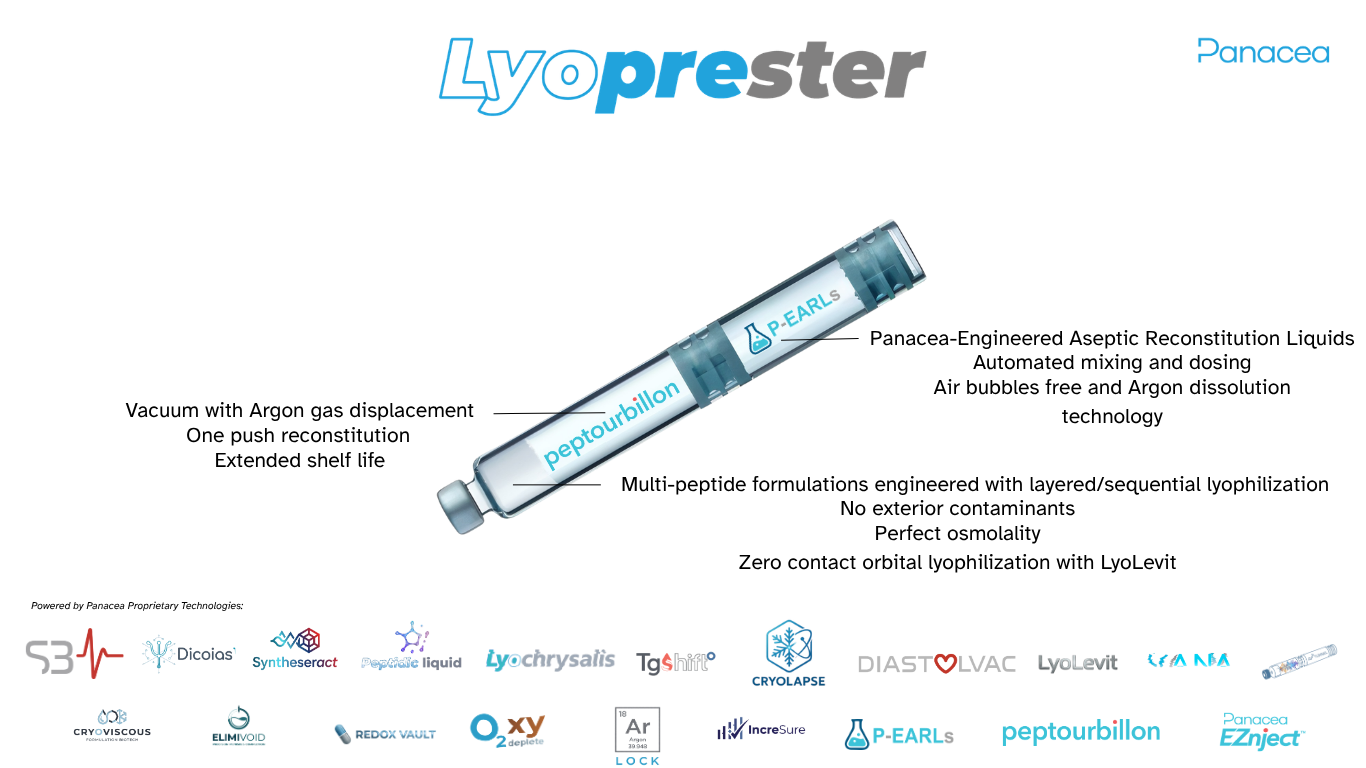
What the Vana Machine does to a Lyoprester® cartridge can be stated plainly as a sequence of outcomes. The pressures, timings, flows and sequences that produce them are proprietary to Panacea Bio Chem and are not published here or anywhere.
by Bogdan Dicoias, biochemist and inventor.
The cycle
- The cartridge enters open.A Lyoprester® arrives from the drying stage with its lyophilized cake below the middle plunger and its P-EARLs™ reconstitution liquid above it. The liquid was degassed before aliquoting, so no air bubble ever formed in it. There is no top plunger and no cap yet.
- Vacuum to just before boiling.The chamber draws the cartridge down toward the pressure at which the reconstitution liquid would boil — and stops just before it. The liquid never boils. What leaves is gas; what stays is liquid, free of the air it would otherwise carry into the closure.
- Argon admitted and dissolved: ArgonLock™.Argon partially replaces the vacuum. It does not sit above the product like a blanket; it dissolves into the P-EARLs liquid and into the cake itself, displacing the oxygen that would otherwise spend the shelf life reacting.
- Top plunger and cap seated under vacuum and argon.Still inside the chamber, still under vacuum and argon, the machine places the top plunger and the cap. The headspace is part hard vacuum, part argon. The Lyoprester becomes a closed system before it ever sees air — no air gap above the liquid, no plunger drift, the target vacuum landed and kept.
- Vent and hand over.The chamber vents and the cartridge comes out. The closure physics placed is held by the pressure difference alone — adequate inside the chamber, temporary outside it. The SealoPrester™ receives the cartridge in exactly that state and applies the permanent mechanical crimp.
The physics in plain words
Why "just before boiling" is the whole point.
A liquid boils when the pressure above it falls to its vapour pressure. Draw the chamber down toward that point and the gases dissolved in the liquid come out first; go past it and the liquid itself turns to vapour, foams and is lost. Vana works at the edge: enough vacuum to strip the gas and set the vacuum the cartridge will keep, never enough to boil the liquid the peptide depends on.
Argon is inert and heavier than air. Admitted into a vacuum, it dissolves into a liquid in place of the gases that were removed. Dissolved oxygen is the reagent of shelf-life oxidation; dissolved argon reacts with nothing. The protection is therefore not a layer over the product but a substitution inside it.
Prevented
Closed under vacuum, there is no pocket of air above the liquid to move, foam or compress.
Prevented
The plungers are seated against a known internal vacuum, not against a room that changes pressure and temperature.
Displaced
Argon takes the place oxygen held in the liquid and the cake; oxidation is starved at the molecular level.
Landed and kept
The vacuum the cartridge needs is set inside the chamber and held by the closure until the moment of use.
Filmed in the laboratory
The Vana Holder in the chamber.
The handover
What leaves Vana is a charged device, not a container.
The cartridge that comes out is vacuum-charged and argon-locked, its cap held only by the internal vacuum, its two plungers free to move if disturbed. That is why the next machine in the line exists: the SealoPrester™ applies the permanent crimp inside a servo-held force window, because the closure until that moment is held by vacuum alone. Vana closes the system in an inert atmosphere; the SealoPrester locks it for the shelf. A crimp applied before the vacuum closure would seal atmosphere in; a vacuum closure never crimped is a leak waiting for a bump.
Proprietary
Vana Machine™ is a proprietary Panacea Bio Chem technology developed and invented by Bogdan Dicoias. Its parameters, sequences and hardware are not publicly disclosed.